
The Lutheran Church is one of the largest Protestant denominations in the world, rooted in the 16th-century Reformation sparked by Martin Luther. Built on the principles of grace, faith, and scripture, it remains a living institution that shapes social policy, interfaith dialogue, and community life across more than 150 countries today.
The Lutheran Church doesn't exist as a single, monolithic organization. It's a global family of denominations — some liturgically conservative, others theologically progressive — united by a shared doctrinal heritage but distinct in how they engage with the modern world. Understanding what the Lutheran Church is means grasping both its historical foundations and its contemporary relevance, which extends far beyond Sunday worship.
Origins and foundations of Lutheranism
Lutheranism didn't emerge from a planned institutional project. It grew out of a theological crisis within Western Christianity, triggered in 1517 when Martin Luther, an Augustinian friar and professor of theology in Wittenberg, published his 95 Theses challenging the Catholic Church's practice of selling indulgences. What began as an academic debate became the spark of the Protestant Reformation, one of the most consequential ruptures in Christian history.
The core principles that defined a new church
Luther's theology crystallized around three Latin phrases that still define Lutheran identity today. Sola scriptura — scripture alone — asserted that the Bible, not papal authority or church tradition, is the ultimate source of Christian truth. Sola fide — faith alone — argued that salvation comes through trust in God's grace, not through human merit or religious works. And sola gratia — grace alone — emphasized that God's forgiveness is an unearned gift, not something to be purchased or performed.
These weren't abstract philosophical positions. They were direct challenges to the institutional power of Rome and to the entire economy of medieval piety. The Augsburg Confession of 1530, drafted largely by Luther's colleague Philip Melanchthon, became the foundational doctrinal document of the Lutheran movement, presented to Holy Roman Emperor Charles V as a formal statement of Protestant belief.
From movement to institution
The transition from reform movement to established church happened gradually and unevenly across German principalities, Scandinavia, and the Baltic states. By the mid-16th century, Lutheranism had become the state religion of several Northern European kingdoms, including Sweden, Denmark, and Norway. This close relationship between church and state shaped Lutheran ecclesiology in ways that still echo today, particularly in the Nordic countries where the relationship between religious institutions and civil society follows patterns distinct from more voluntarist Protestant traditions.
Lutheran beliefs and worship practices
Lutheran theology occupies a specific position within the broader Protestant landscape. It's neither as liturgically stripped-down as Reformed traditions nor as ceremonially elaborate as Catholicism. The result is a worship culture that values both doctrinal precision and aesthetic richness.
The sacraments and their distinctive interpretation
The Lutheran Church maintains two sacraments: baptism and the Eucharist (also called the Lord's Supper or Holy Communion). Both are considered genuine means of grace — not merely symbolic acts, but occasions where God actively works through physical elements.
On the Eucharist, Lutheran doctrine holds a position called "real presence": Christ is truly present in, with, and under the bread and wine. This distinguishes Lutheranism sharply from the Reformed tradition (represented by Calvin and later by Presbyterian and Baptist churches), which understands communion as primarily a memorial act. But it also differs from Catholic transubstantiation, which holds that the bread and wine literally become Christ's body and blood. Lutheran theology rejects the philosophical framework of transubstantiation while affirming the reality of Christ's presence — a nuanced position that has generated centuries of ecumenical debate.
Baptism, in Lutheran practice, is administered to infants as well as adults, and is understood as the moment of genuine spiritual regeneration. This sacramental theology has direct implications for how Lutheran communities understand membership, belonging, and salvation.
Lutheran worship typically follows a structured liturgy rooted in pre-Reformation Christian tradition. Elements like the Kyrie, the Gloria, and the Nicene Creed remain central to Sunday services in most Lutheran congregations worldwide.
Scripture, preaching, and the role of tradition
Preaching holds a central place in Lutheran worship — a direct legacy of Luther's conviction that the Word of God, proclaimed and heard, is itself a means of grace. But Lutheranism never abandoned liturgical form the way more radical Reformation movements did. The Book of Concord (1580), which collects the foundational Lutheran confessional documents, explicitly affirms continuity with the ancient church while rejecting what it identifies as Roman corruptions.
This tension between reform and continuity is part of what makes Lutheran identity complex. The church sees itself not as a new institution but as a reformed expression of the one, holy, catholic, and apostolic church — a claim that has significant implications for its approach to ecumenism.
The Lutheran Church today
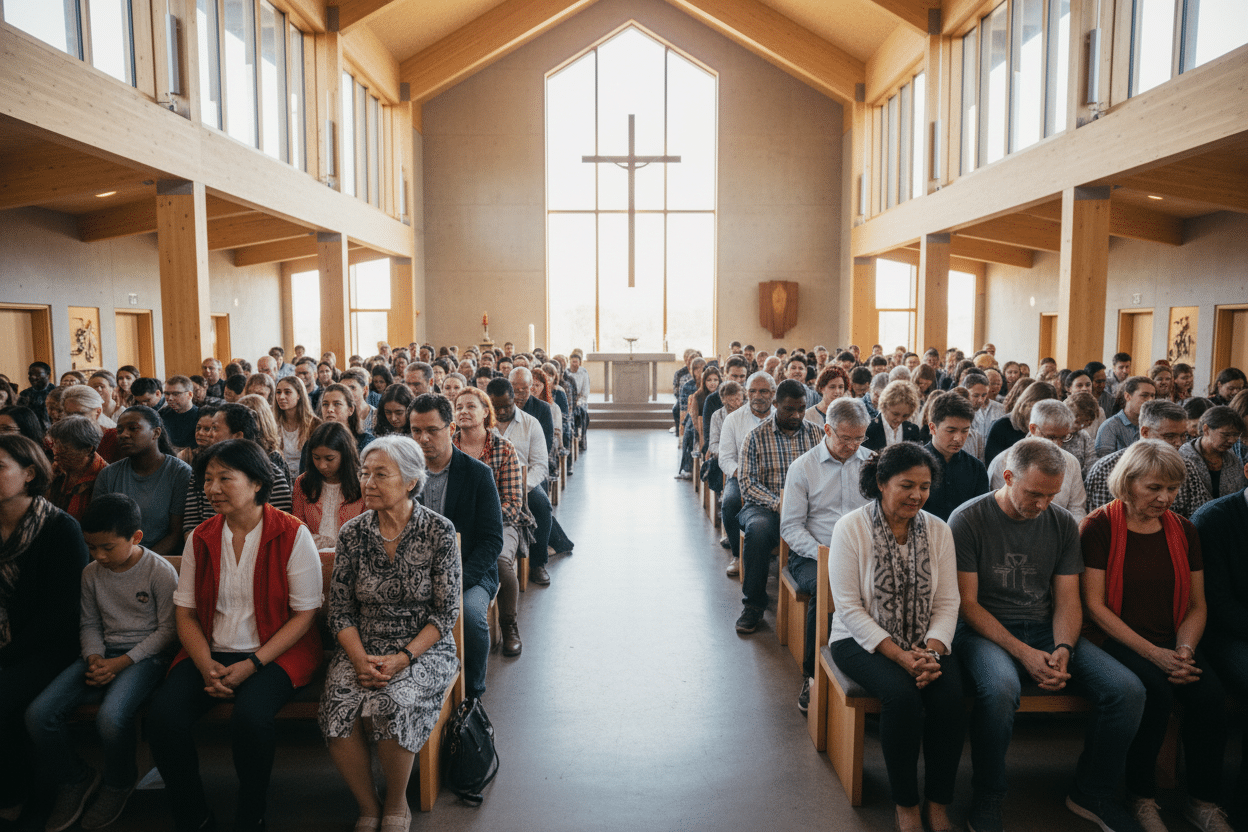
The global Lutheran community today comprises roughly 77 million baptized members, organized primarily through the Lutheran World Federation (LWF), founded in 1947. The LWF brings together 148 member churches from across Africa, Asia, Latin America, Europe, and North America, making it one of the largest international Christian organizations in existence.
Major Lutheran denominations and their divergences
In the United States, the landscape is divided primarily between the Evangelical Lutheran Church in America (ELCA) — the largest Lutheran body, with approximately 3.3 million members — and the Lutheran Church–Missouri Synod (LCMS), which holds more theologically conservative positions. The ELCA ordains women and LGBTQ+ clergy and has moved toward progressive social stances on a range of issues. The LCMS maintains traditional positions on gender roles and sexuality, reflecting a broader tension within global Lutheranism between confessional conservatism and theological adaptation.
This internal diversity is not a weakness — it reflects the genuine breadth of a tradition that has always contained competing impulses. Just as questions about church architecture and orientation reveal deep theological commitments across Christian traditions, the debates within Lutheranism about ordination and social ethics reveal how seriously these communities take the task of applying ancient convictions to contemporary realities.
Social engagement and institutional presence
Lutheran churches run some of the world's largest humanitarian networks. Lutheran World Relief, Lutheran Social Services, and affiliated organizations operate across dozens of countries, providing disaster relief, refugee resettlement, education, and healthcare. In the United States alone, Lutheran Social Services agencies serve millions of people annually, regardless of religious affiliation. This diaconal tradition — the idea that service to the neighbor is inseparable from Christian identity — is not incidental to Lutheran theology. It flows directly from Luther's doctrine of vocation, which holds that every person's work, not just ordained ministry, can be a form of service to God and neighbor.
- Strong humanitarian and social service networks globally
- Rich liturgical and theological tradition
- Active ecumenical engagement with Catholic and Orthodox churches
- Presence in over 150 countries through the Lutheran World Federation
- Significant membership decline in Western Europe and North America
- Deep internal divisions over social and theological issues
- Tension between progressive and confessional wings
- Institutional legacy of state-church models in a post-Christian context
Interfaith dialogue and ecumenism
The Lutheran Church's engagement with other Christian traditions and world religions is one of its most consequential contemporary contributions. This isn't a recent development — it's embedded in the tradition's self-understanding as a reformed but not separated branch of the universal church.
The Joint Declaration on the Doctrine of Justification
The most historically significant ecumenical achievement of modern Lutheranism came in 1999, when the Lutheran World Federation and the Roman Catholic Church signed the Joint Declaration on the Doctrine of Justification. This document declared that the fundamental disagreement over salvation that sparked the Reformation — whether humans are justified by faith alone or by faith and works — had been substantially resolved through dialogue. The declaration was later endorsed by the World Methodist Council (2006) and the Anglican Communion (2017).
This is not a minor diplomatic gesture. The doctrine of justification was the theological heart of the Reformation split. Reaching a common statement on it, after nearly 500 years of separation, represents one of the most significant moments in Christian ecumenism since the Great Schism of 1054. It doesn't mean reunion — far from it — but it signals that the most bitter doctrinal wound of Western Christianity has been substantially addressed.
Dialogue beyond Christianity
Lutheran engagement extends beyond intra-Christian ecumenism. The Lutheran World Federation maintains formal dialogues with Jewish, Muslim, and Buddhist organizations. The 2016 commemoration of the Reformation's 500th anniversary, co-organized with the Catholic Church in Lund, Sweden, was explicitly framed as an act of repentance for centuries of division and hostility. This capacity for institutional self-criticism — rooted in Lutheran theology's emphasis on the church as always in need of reform (ecclesia semper reformanda) — gives the tradition a distinctive voice in interfaith spaces.
The LWF has also been vocal on issues like climate change, migration, and global inequality, framing these as theological concerns rather than merely political ones. This positions the Lutheran Church as a participant in global policy debates in ways that parallel, and sometimes collaborate with, institutions like the Catholic Church on shared social concerns.
The future of Lutheranism in a changing world
Lutheranism faces a paradox. Its global footprint is expanding — particularly in sub-Saharan Africa and parts of Asia, where Lutheran churches are growing rapidly — while its traditional heartlands in Northern Europe and North America are experiencing steep decline. The Church of Sweden, once the world's largest Lutheran body, has lost millions of members since disestablishment in 2000. German Lutheran churches face similar trajectories.
The Global South and the shift in the center of gravity
The growth of Lutheranism in Ethiopia, Tanzania, Madagascar, and Indonesia is reshaping the denomination's cultural and theological center of gravity. The Ethiopian Evangelical Church Mekane Yesus, with over 10 million members, is one of the fastest-growing Lutheran churches in the world. These communities bring different priorities — a stronger emphasis on evangelism, healing, and community solidarity — that challenge the more institutionally cautious approach of European Lutheranism.
This demographic shift mirrors what has happened across global Christianity, where the center of Christian life has moved decisively southward. For Lutheranism, this means navigating genuine theological diversity within its confessional framework, as African and Asian churches often hold more conservative social positions than their European and North American counterparts.
Maintaining identity in a post-institutional age
The deeper challenge for Lutheranism — and for all mainline Protestant traditions — is institutional. In societies where religious affiliation is increasingly voluntary and where identity is constructed rather than inherited, the old model of territorial parish churches serving geographically defined communities no longer functions as it once did. Lutheran communities that are growing tend to be those that have developed strong programmatic identities, robust community engagement, and clear theological articulation of why their tradition matters.
The answer, for Lutheranism, may lie precisely in what it has always insisted upon: that grace is unconditional, that service to the neighbor is the form faith takes in the world, and that the church is always in the process of being reformed. These convictions don't guarantee institutional survival — but they offer a coherent basis for engagement with a world that has changed dramatically since 1517, and that continues to change faster than any church can comfortably manage.
The Lutheran Church is not a relic of the Reformation era. It is a living, internally diverse, globally present institution that continues to engage seriously with theology, social ethics, and interfaith dialogue — even as it navigates significant demographic and institutional pressures in its traditional strongholds.