Churches have traditionally been built facing east — toward the rising sun — as a symbol of Christ's resurrection and the anticipated Second Coming. But this practice has never been universal. Geography, local culture, urban constraints, and denominational theology have always shaped how a church is oriented, and the 21st century has largely untethered new construction from these ancient conventions.
The question "do all churches face east?" sounds simple. The answer is not. Behind it lies more than a thousand years of liturgical debate, architectural tradition, and practical compromise. From the great cathedrals of medieval Europe to the concrete megachurches of suburban America, orientation has always meant something — even when it was ignored.
Orientation in religious architecture carries deep spiritual weight
The practice of orientatio — from the Latin oriens, meaning east — is one of the oldest principles in Christian architecture. Early Christians inherited it partly from Jewish temple tradition and partly from a broader Mediterranean religious culture in which the rising sun held profound symbolic significance.
The theological roots of eastward orientation
The logic is straightforward: east is where the sun rises, and in Christian theology, the resurrection of Christ is compared to a new dawn. The Gospel of Matthew describes the Second Coming as appearing "like lightning from the east," which gave eastward orientation an eschatological dimension. Worshippers facing east were, symbolically, facing the return of Christ.
This wasn't merely poetic. Origen of Alexandria, writing in the 3rd century, explicitly defended eastward prayer as a theological necessity. The practice was codified in early church councils and architectural manuals throughout the Byzantine and Romanesque periods. By the Middle Ages, the alignment of a church's nave — with the altar at the eastern end and the entrance at the west — had become the dominant model across Latin Christendom.
Liturgical east versus geographic east
Here is where the concept becomes more nuanced. Many architects and clergy drew a distinction between liturgical east and geographic east. A church could be "oriented" in the liturgical sense — meaning the altar faced the direction of prayer, the congregation faced forward toward the apse — without actually pointing toward the geographic east. What mattered, in many traditions, was the symbolic gesture rather than the compass bearing.
This distinction explains why so many churches that appear "oriented" in their interior arrangement are, in fact, pointing northwest, south, or southwest when measured against an actual compass.
The term “orientation” itself derives from the Latin word for east (oriens). When a building is “oriented,” it is literally being aligned with the east — though common usage has since broadened the word to mean any directional alignment.
Different Christian denominations approach orientation very differently
No single rule governs all of Christianity. The Roman Catholic Church, the Eastern Orthodox Church, Protestant denominations, and newer evangelical movements each carry distinct traditions — and distinct levels of concern — regarding which direction their buildings face.
Eastern Orthodoxy: the strictest adherence
Among major Christian traditions, Eastern Orthodoxy maintains the most rigorous commitment to eastward orientation. Orthodox church architecture treats the altar as sacred space facing east, and this is rarely compromised. The iconostasis — the screen separating the nave from the sanctuary — reinforces a liturgical directionality that is deeply embedded in Orthodox theology and ritual. For Orthodox communities, the orientation of a church is not an aesthetic preference but a doctrinal expression.
Roman Catholicism: tradition with flexibility
The Catholic Church historically followed the same eastward orientation, and many of its great pre-modern churches reflect this. But Vatican II in the 1960s introduced significant liturgical reforms, including the shift to versus populum celebration — the priest facing the congregation across the altar rather than facing east alongside them. This reform didn't change the requirement for physical orientation, but it subtly decoupled the liturgical gaze from the architectural one. Post-conciliar Catholic churches are far more variable in their geographic orientation, with site constraints and pastoral considerations taking precedence.
Protestant traditions: orientation as a secondary concern
Most Protestant denominations — Lutheran, Reformed, Baptist, Methodist — never invested the same theological weight in eastward orientation. The Reformation's emphasis on scripture, preaching, and congregational participation shifted architectural priorities toward acoustics and visibility rather than compass direction. Protestant churches from the 17th century onward were built to face whatever direction the site demanded, with the pulpit as the focal point rather than an altar oriented toward Jerusalem or the rising sun.
Geography and urban context override ancient rules in practice
The honest reality of church construction, across every era, is that site constraints have always competed with theological ideals. A city block, a hilltop, a riverbank — these physical realities shaped churches as much as any liturgical manual.
Medieval compromises and urban planning
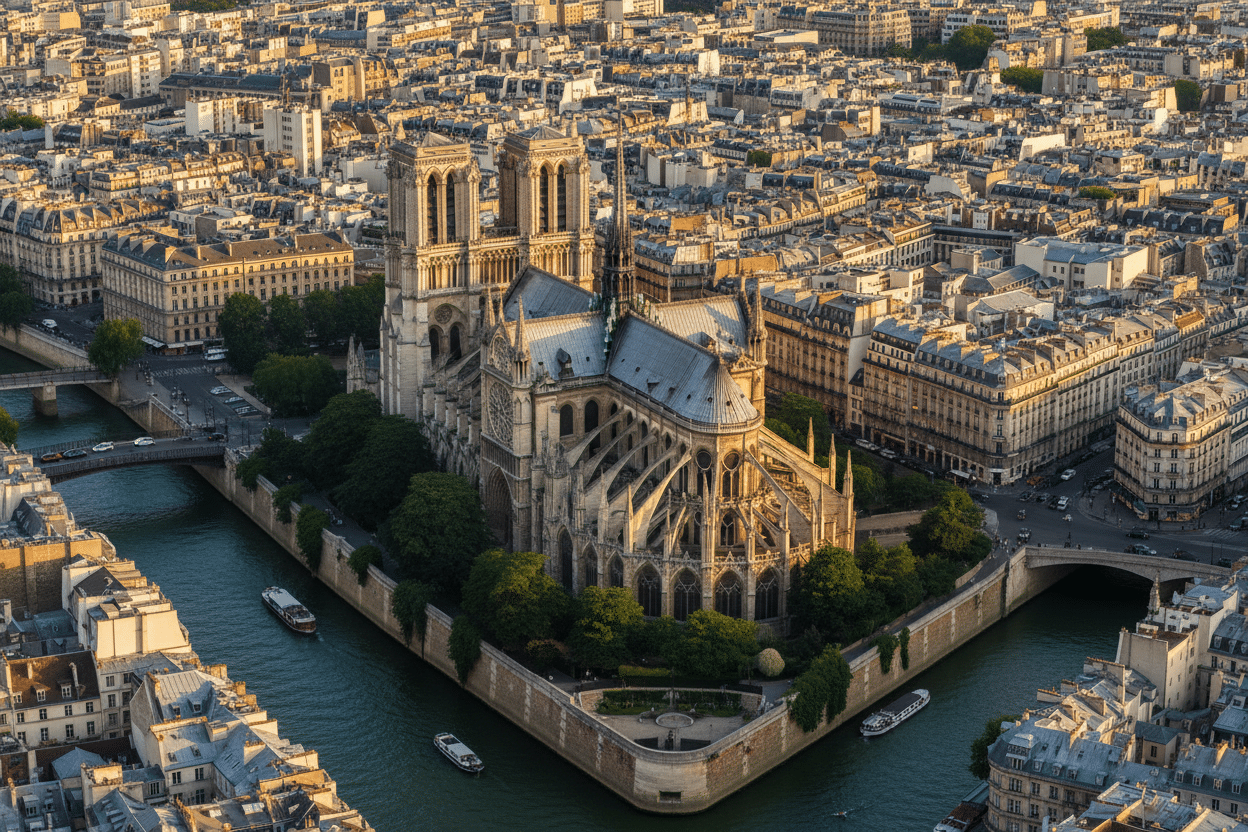
Even in the Middle Ages, when eastward orientation was at its most doctrinally charged, exceptions were common. Notre-Dame de Paris faces west at its entrance, which is standard — but its nave axis deviates noticeably from true east due to the constraints of the Île de la Cité. Canterbury Cathedral is similarly misaligned with geographic east. Urban parcels, pre-existing road networks, and the desire to face a public square or a major street frequently trumped strict compass alignment.
In some cases, the deviation was intentional. A number of medieval churches were oriented toward the sunrise on the feast day of their patron saint rather than true geographic east, introducing a seasonal and liturgical layer to the alignment that has fascinated archaeoastronomers for decades.
Cultural geography beyond Europe
Outside of Western and Byzantine Christianity, the very concept of eastward orientation takes on different meanings. Ethiopian Orthodox churches, among the oldest continuously active Christian communities in the world, follow their own Alexandrian traditions with specific architectural requirements that don't always map onto European conventions. Coptic churches in Egypt integrate local building traditions alongside liturgical orientation rules.
And in regions where Christianity arrived through colonialism or missionary activity — sub-Saharan Africa, Latin America, Southeast Asia — church orientation often reflects a negotiation between imported European models and local spatial traditions. A church built by a Spanish colonial mission in Mexico or Peru in the 16th century was shaped as much by the logic of the plaza mayor as by any liturgical compass.
Assuming a church faces east based on its appearance or tradition alone is unreliable. Many celebrated “oriented” churches deviate significantly from true geographic east when measured accurately. Always verify with a compass or mapping tool.
Notable churches and their actual orientations reveal the complexity
Looking at specific, well-documented examples dismantles the idea that eastward orientation is a universal rule — even among the most architecturally significant religious buildings in the world.
The great cathedrals of Europe
Chartres Cathedral in France is one of the most studied medieval buildings in the world. Its orientation deviates from true east by several degrees — a deviation some researchers attribute to solar alignment on the summer solstice, others to the limitations of the medieval site. Cologne Cathedral, one of the largest Gothic churches in Northern Europe, follows a more conventional east-west axis, but again with measurable deviation from geographic east.
St. Peter's Basilica in Vatican City is a particularly striking case. The basilica faces west — its main entrance opens to the east, and the altar is at the western end — which is actually the reversed orientation compared to the standard medieval model. This reflects the ancient Roman basilica form that Constantine adopted in the 4th century, where the apse was at the west end facing the entrance. Early Christians entering St. Peter's would walk eastward toward the altar, which preserved the directional symbolism through movement rather than static orientation.
Orthodox churches in practice
In Russia and Greece, where Orthodox church-building traditions have remained strong, the commitment to eastward orientation is more consistent than in the West. Hagia Sophia in Istanbul — originally built as the cathedral of Constantinople in 537 AD — is oriented roughly east-west, though its precise alignment has been the subject of scholarly debate. Its conversion to a mosque in 1453 and again in 2020 introduced the complication of the qibla (the Islamic direction of prayer toward Mecca), which in Istanbul points roughly southeast, creating a tension between the building's original Christian orientation and its Islamic liturgical requirements.
- Preserves a millennium of theological and architectural tradition
- Reinforces the eschatological symbolism of the Second Coming
- Creates a coherent liturgical directionality in the worship space
- Connects local communities to a global and historical Christian practice
- Urban site constraints make strict orientation impossible in most cities
- Post-Vatican II liturgical reforms reduced the functional importance of altar direction
- Many Protestant traditions never adopted the practice as doctrinally significant
- New architectural priorities — acoustics, natural light, community gathering — often conflict with compass alignment
Contemporary church architecture has largely moved past the question
The 20th and 21st centuries have produced a church architecture that is, for the most part, indifferent to compass orientation. This is not a loss of faith — it reflects a genuine shift in how religious communities understand sacred space.
Modernism and the rethinking of sacred geometry
The modernist movement in architecture, which reshaped religious building from the 1920s onward, rejected historical symbolism in favor of structural honesty, natural light, and spatial experience. Le Corbusier's Chapel of Notre-Dame du Haut in Ronchamp, France (completed in 1955) is a landmark of 20th-century religious architecture. Its orientation is entirely determined by the hillside site and the architect's sculptural vision — geographic east is irrelevant to its design logic.
This approach has become the norm rather than the exception. Contemporary megachurches in the United States, purpose-built evangelical campuses in South Korea, and new Catholic parishes across Europe are designed around parking access, auditorium acoustics, natural lighting strategies, and community programming needs. The altar's compass bearing is rarely on the agenda.
The liturgical movement's counterreaction
Not everyone has abandoned the tradition. A significant liturgical renewal movement within Catholicism and high-church Anglicanism has, since the 1990s, pushed back against the functional pragmatism of post-conciliar church design. Theologians like Romano Guardini and architects influenced by the Communio Internationalis Leodegarii have argued for a return to ad orientem worship and architecturally expressed orientation. New traditional Catholic communities — including those affiliated with the Traditional Latin Mass — frequently prioritize eastward-facing altars even in newly built or renovated spaces.
The debate is alive. But it remains a minority position within global Christian architecture, where the dominant trend is the church as a flexible, multi-use, community-centered building that happens to contain a worship space — not a cosmic instrument aligned with the rising sun. Whether that represents progress or loss depends entirely on what one believes a church is for.