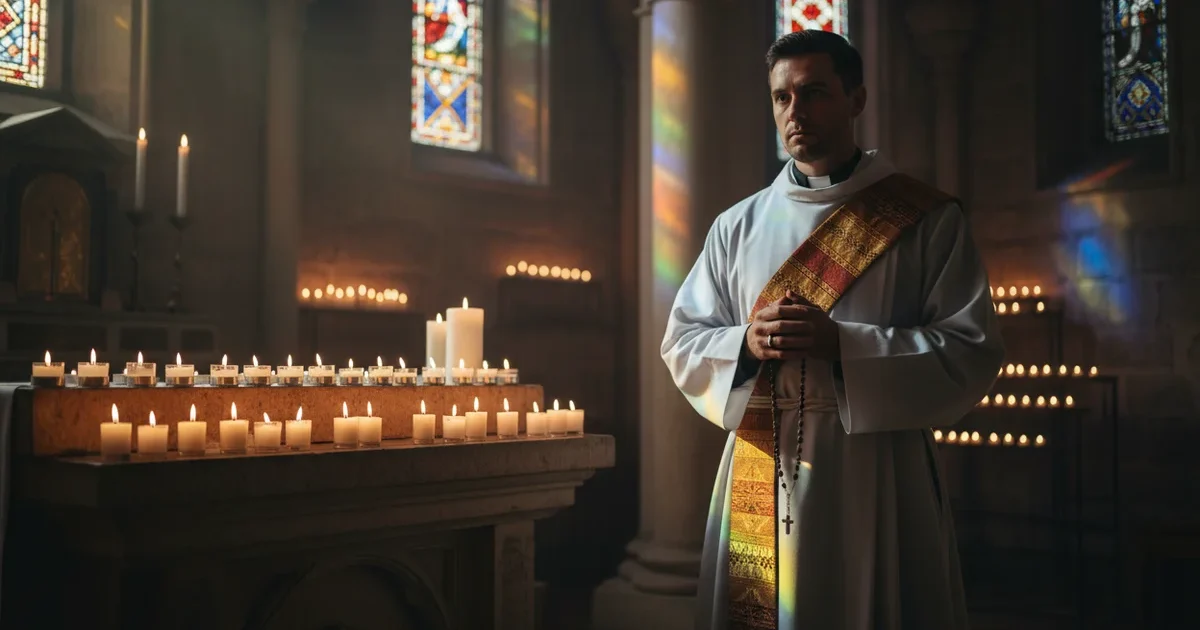
Deacons are ordained ministers of the Catholic Church, distinct from priests and bishops yet fully part of Holy Orders. They preach, baptize, witness marriages, and serve the poor — a ministry rooted in the Acts of the Apostles and restored in its permanent form by the Second Vatican Council. Understanding what a deacon is in the Catholic Church means understanding a vocation built entirely around service.
While bishops and priests tend to occupy the spotlight in Catholic life, the diaconate represents something equally fundamental to the Church's structure. Deacons are not priests in training, nor are they laypeople with extra responsibilities. They are ordained ministers, marked by the sacrament of Holy Orders, whose specific charism is diakonia — a Greek word meaning service. And yet, outside of Catholic circles, their role remains widely misunderstood.
The renewed visibility of deacons in parishes across the United States and Europe reflects a broader shift in how the Church thinks about ministry. There are currently more than 50,000 permanent deacons worldwide, roughly half of them in the United States alone. That number has grown steadily since the 1960s, when the Second Vatican Council reopened a door that had been closed for over a millennium.
What is a deacon in the Catholic Church?
A deacon is an ordained minister who belongs to the first degree of Holy Orders, below the priesthood and the episcopate. His ordination is sacramental — not a blessing, not a commissioning, but a permanent transformation of identity through the laying on of hands by a bishop.
The word "deacon" comes from the Greek diakonos, meaning servant or minister. The role appears explicitly in the New Testament, most notably in Acts 6, where the apostles designate seven men — including Stephen and Philip — to oversee the distribution of food to widows in the early Jerusalem community. This act of organized charitable service is widely regarded as the scriptural foundation of the diaconate.
Biblical roots and early Church practice
From the outset, the deacon's role combined liturgical participation with direct service to the poor. Paul's letters to Timothy and Philippians reference deacons as a recognized order within the community, describing qualities expected of them: integrity, sobriety, and a sincere faith. In the early Church, deacons managed the material resources of the community, assisted at the Eucharist, proclaimed the Gospel, and served as the bishop's primary agents in charitable work.
By the medieval period, the diaconate had largely become a transitional step on the way to priesthood rather than a permanent vocation in its own right. The Second Vatican Council (1962-1965) changed that. Its document Lumen Gentium explicitly restored the permanent diaconate as a stable rank of the hierarchy — a decision that reshaped Catholic ministry for the following decades. To understand when the Catholic Church formalized these structures, it helps to see the diaconate not as an invention of Vatican II but as a recovery of something ancient.
What deacons can and cannot do
The scope of diaconal ministry is specific and worth stating clearly. A deacon can:
- Proclaim the Gospel and preach at Mass
- Baptize
- Witness and bless marriages
- Lead funeral rites and burial services
- Distribute the Eucharist
- Lead prayer services and Liturgy of the Hours
A deacon cannot celebrate Mass, hear confessions, or administer the sacrament of the Anointing of the Sick. These remain reserved to priests. The distinction matters not because deacons are lesser, but because each order within Holy Orders has its own proper function.
The permanent diaconate vs. the transitional diaconate
This is where confusion most often arises. The Catholic Church has two distinct forms of the diaconate, and conflating them misrepresents both.
Transitional deacons: a step toward priesthood
A transitional deacon is a seminarian who has been ordained to the diaconate as part of his formation for the priesthood. He typically serves as a deacon for six months to a year before being ordained a priest. His diaconal ordination is genuine and sacramental, but it is understood from the beginning as a stage in a larger journey. Transitional deacons are celibate, as they are preparing for priestly celibacy.
Permanent deacons: a vocation in its own right
A permanent deacon, by contrast, enters the diaconate as his final ordained state. He does not go on to become a priest. Permanent deacons are typically men aged 35 or older (the minimum age set by canon law), and they may be married, provided they were married before their ordination. If a permanent deacon's wife dies, he is generally not permitted to remarry, though bishops can grant exceptions.
The formation program for permanent deacons usually spans three to five years, combining theological study, pastoral training, and supervised ministry. It is rigorous — not a weekend course, but a serious academic and spiritual formation program that runs alongside a man's existing professional and family life.
In the United States, the permanent diaconate was formally restored in 1968, just three years after the close of Vatican II. Today, the U.S. has the largest population of permanent deacons in the world — approximately 18,000 — representing roughly a third of the global total.
The responsibilities of deacons in modern parishes
In practice, the diaconal ministry looks different from one parish to the next. But certain functions appear consistently wherever permanent deacons serve.
Liturgical and sacramental roles
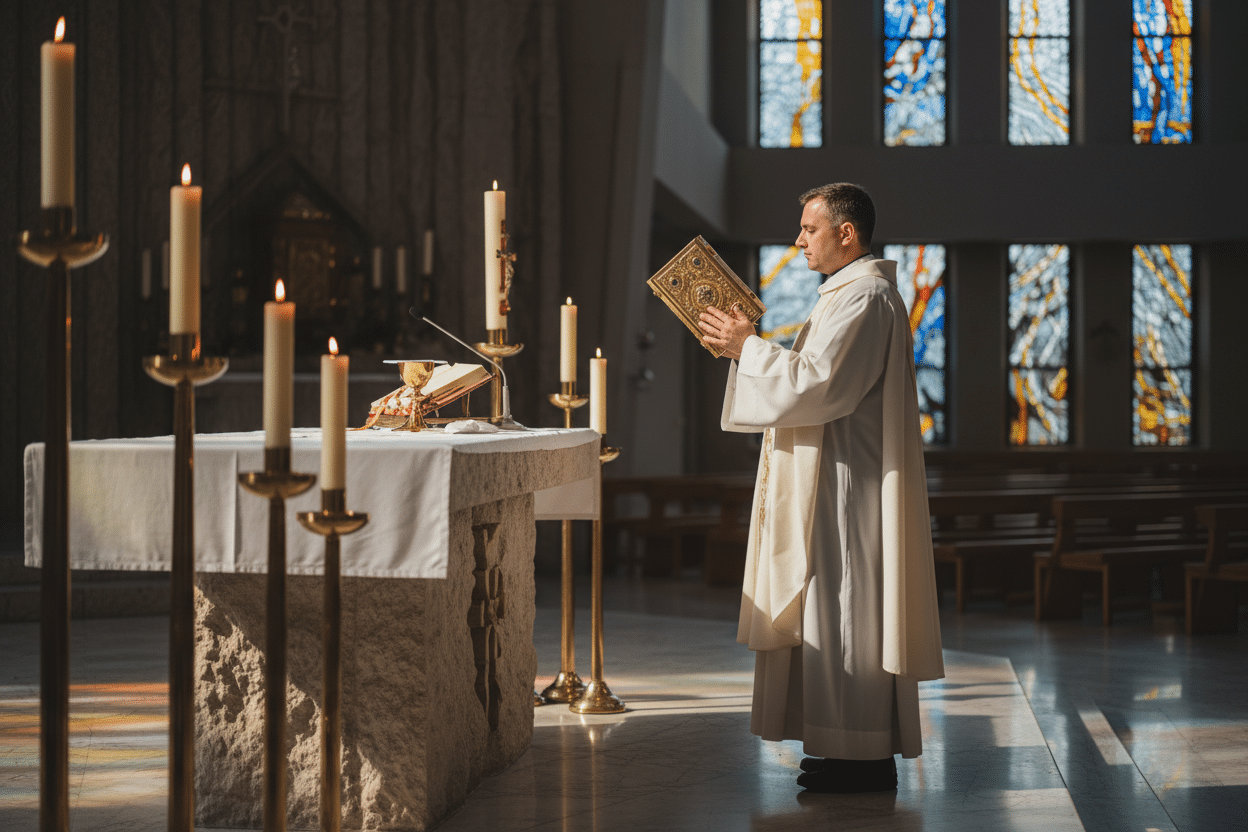
At Sunday Mass, the deacon's presence is visible: he proclaims the Gospel, delivers the homily (with the pastor's permission), assists the priest at the altar, and often dismisses the assembly. At baptisms, he may be the primary minister. At weddings, he can officiate the entire ceremony. At funerals, he leads the vigil service and the rite of committal at the graveside.
These are not ceremonial extras. They represent real pastoral care at some of the most significant moments in a family's life — the birth of a child, a marriage, the death of a parent. Deacons are often the ministers who accompany families through these transitions, sometimes with a depth of personal connection that comes precisely from their own lived experience as husbands and fathers.
Service and social ministry
The charitable dimension of diaconal service is not incidental — it is definitional. Many permanent deacons work directly in social ministry: visiting the sick and imprisoned, coordinating food pantries, organizing outreach to homeless populations, or advocating within their professional lives (as lawyers, doctors, social workers, teachers) for the communities they serve.
This dual life — ordained minister and working professional — is one of the distinctive features of the permanent diaconate. A deacon who works as a hospital administrator brings his ministry into that environment. One who practices law may serve on a pro bono basis for parishioners who cannot afford legal counsel. The diaconal vocation does not require leaving the world behind; it requires bringing the Church's mission into it.
How deacons shape community life
The impact of deacons on parish life is difficult to quantify but easy to observe. In parishes where deacons are active, ministry tends to be more broadly distributed. Priests are freed to focus on the sacraments most proper to their order. And parishioners often find in their deacon someone who understands the pressures of ordinary life — mortgage payments, teenagers, workplace conflict — because he lives them too.
- A ministry rooted in lived experience as husbands and fathers
- Direct connection to social and charitable outreach
- Availability for pastoral visits, hospital calls, and funeral ministry
- A bridge between the ordained ministry and the lay faithful
- Cannot celebrate Mass or hear confessions
- Typically serve part-time alongside secular employment
- Role varies significantly by diocese and pastor
- Still largely unknown or misunderstood by many Catholics
Deacons as a bridge between clergy and laity
One of the most significant contributions of the permanent diaconate is structural. Deacons occupy a unique position: they are ordained, but many of them live lives that closely resemble those of the laypeople they serve. They are not set apart by celibacy or the cloister. They coach their kids' soccer teams. They commute to work. They worry about aging parents.
This proximity gives them a particular kind of pastoral credibility. When a deacon speaks about suffering, or about the difficulty of maintaining faith through hardship, he often speaks from personal experience in a way that resonates differently than a homily from a celibate priest — not better, but different, and genuinely complementary. The Church, in restoring the permanent diaconate, recognized that this complementarity has value.
The diaconate also opens questions about ministry and vocation that extend beyond Catholicism. Readers curious about how other Christian traditions structure ordained ministry might find it useful to explore how Episcopal churches organize their clergy, where the diaconate also exists in a distinct form.
What deacons themselves say about their vocation
Accounts from permanent deacons consistently point to a few recurring themes: the sense of being called to serve rather than to lead, the challenge of balancing family and ministry, and the unexpected depth of pastoral encounters.
The call to serve, not to advance
Many deacons describe their ordination not as a promotion but as a formalization of something they were already doing. They were already visiting the sick, already volunteering at shelters, already teaching faith formation. The diaconate gave that service a sacramental grounding and an ecclesial mandate — but the orientation was already there.
This matters because it points to something the Church has consistently taught about the diaconate: it is not a consolation prize for men who "couldn't become priests," nor a stepping stone for those who might eventually pursue priesthood. It is a vocation complete in itself, ordered entirely toward service. The Latin phrase in persona Christi servi — in the person of Christ the servant — captures the theological core of what a deacon is meant to embody.
Family life and ministry in tension
Married permanent deacons frequently speak about the demands of balancing their roles. A wife's support is not incidental to diaconal ministry — canon law actually requires the consent of a deacon candidate's wife before he can be ordained. Many dioceses involve wives formally in the formation process, recognizing that a deacon's family is, in a real sense, part of his ministry.
The tension is real. A deacon called to a hospital at midnight is also a husband and father. Parishes that support their deacons well understand this tension and structure expectations accordingly. Those that treat deacons as free labor for every task a priest doesn't want to do tend to burn through them quickly.
A permanent deacon is an ordained minister whose vocation is defined by service — liturgical, sacramental, and social. He is neither a proto-priest nor an elevated layperson, but a distinct order within Holy Orders whose restoration has fundamentally expanded how the Catholic Church delivers pastoral care at the parish level.
The diaconate, in the end, is one of the clearest expressions of a Church that understands itself as servant rather than institution. In a parish with an active deacon, that service tends to be visible, concrete, and local — which is exactly what the early Church had in mind when it appointed seven men to make sure the widows got fed.