
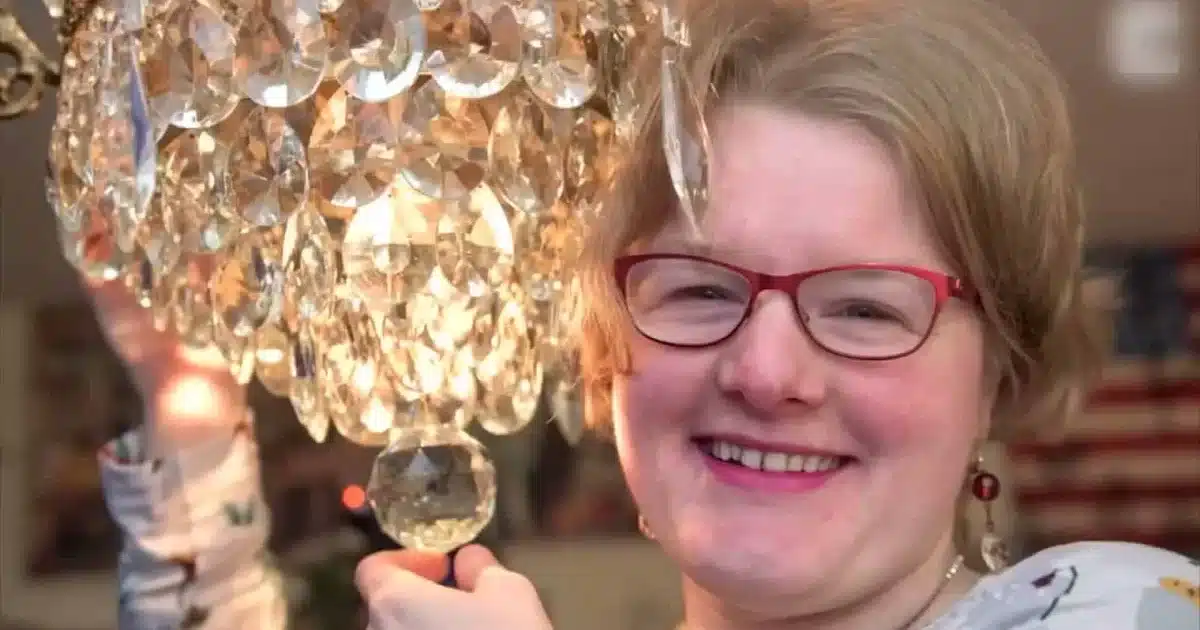
Amanda Liberty, a woman from Leeds, England, is in a committed romantic relationship with a chandelier named Lumière — a 100-year-old fixture she purchased on eBay from Germany. As an objectophile, she faces widespread misunderstanding but continues to advocate publicly for the acceptance of all identities and orientations.
There are love stories that defy easy categorization, and then there is Amanda's. She dusts the crystals. She rearranges them carefully, watching how the light bends and scatters through the glass. She has given her chandelier a name — Lumière — and she means it with the full weight of romantic devotion.
To the outside world, this is confusing at best, ridiculous at worst. To Amanda, it is simply her life.
Objectophilia: what it actually means
Objectum sexuality, also referred to as objectophilia, describes a deep emotional or romantic attachment to inanimate objects rather than to people. It is not a fetish, not a phase, and not a cry for attention — at least not according to those who identify with it. The spectrum is wide, ranging from attractions to everyday objects to iconic landmarks.
Amanda's own history with this orientation stretches back to adolescence, when her first documented romantic attractions were directed toward a drum set, the American flag, and the Statue of Liberty. These were not passing curiosities. They were the early signals of an identity that would take years to understand and even longer to speak about openly.
A relationship with a history
Lumière is no ordinary fixture. The chandelier is 100 years old, purchased by Amanda through eBay from a seller in Germany, and now lives at her home in Leeds. The acquisition itself was deliberate — this was not an impulse buy but a search for connection. Amanda describes her relationship with Lumière as her primary romantic bond, though she also maintains what she calls an open relationship with other objects. She has had past romances with humans, which situates her experience within a broader and more complex emotional history than the tabloid version tends to acknowledge.
Her daily rituals are telling. Dusting the crystals, adjusting them, sitting with the play of light through glass — these are acts of care and attention that mirror what many people do in intimate relationships. The difference is the nature of the recipient.
Objectum sexuality encompasses a spectrum of deep emotional or romantic attachments directed toward inanimate objects. It is distinct from fetishism and is considered by those who experience it as a genuine orientation, not a behavioral choice.
The social cost of an unconventional identity
Amanda shares her story publicly — through interviews, through social media, through the kind of visibility that takes courage when the response ranges from genuine curiosity to outright mockery. And the mockery comes. Online, her experience is frequently reduced to spectacle, a punchline for people who find the concept absurd rather than worth understanding.
But the social cost runs deeper than internet comments. Objectophiles occupy an identity that has no legal recognition in most jurisdictions. Symbolic ceremonies — whether framed as engagement or marriage — carry no legal weight. The cultural acknowledgment of objectum sexuality remains minimal, and the support networks that do exist are growing, but slowly. Amanda stays connected to that community, maintaining contact with other objectophiles who share similar experiences.
Visibility without protection
There is a particular kind of exposure that comes without institutional backing. Amanda can speak publicly, build a following, and advocate for acceptance, but the structures that protect more recognized relationships simply do not apply. The legal landscape for non-conventional romantic relationships remains uncertain, and there is no equivalent to the frameworks that have developed — unevenly and over decades — for other marginalized orientations.
This matters not just symbolically. It shapes how objectophiles navigate healthcare conversations, social services, and even the basic question of being taken seriously by the people around them. Friends visit Amanda's home and admire Lumière. That informal acceptance is real. But it exists alongside a broader cultural framework that either ignores or pathologizes her experience.
Symbolic ceremonies between a person and an object — including engagement or marriage rituals — hold no legal validity in any known jurisdiction. Objectophiles have no formal protections for their romantic relationships under existing law.
Amanda's advocacy and what she's building
Amanda does not simply live her truth privately — she argues for it. Her public presence is deliberate, oriented toward breaking stereotypes and pushing back against the assumption that there is one acceptable shape for human attachment. She advocates for the acceptance of all orientations, including her own, and she does this knowing that the media often frames her story as entertainment rather than testimony.
The comparison to other forms of identity acceptance is not lost on her or on the broader conversation around objectum sexuality. Just as questions of religious identity and institutional belonging have evolved over time through visibility and advocacy, non-mainstream orientations require sustained public engagement to shift cultural defaults. Recognition does not arrive on its own.
What Amanda is doing — speaking, connecting with others, performing the daily rituals of a relationship she takes seriously — is both personal and political. The community of objectophiles she participates in is small and growing slowly, but it exists. And the existence of a community changes things, even when the legal and cultural structures have not caught up.
years old — the age of Lumière, Amanda’s chandelier and primary romantic partner
Lumière hangs at home in Leeds, catching light the way it has for a century. Amanda arranges the crystals, watches the refraction, and continues to explain herself to a world that finds her hard to categorize. The incomprehension is real. But so, she insists, is the relationship — and she is not asking permission to feel what she feels. She is asking, more simply and more defiantly, to be understood.