David Hole spent years convinced he had struck gold. The heavy, reddish rock he pulled from the ground in 2015 near Maryborough, Australia turned out to be something far rarer: a meteorite that predates Earth itself, carrying mineral grains formed at the very dawn of the Solar System.
When a man walks a field with a metal detector, he's usually dreaming of gold nuggets. What David Hole found instead was a 17-kilogram reddish rock that refused to give up its secrets — and that resistance, as it turned out, was the first clue that this was no ordinary find.
The story stretches from a regional park in Victoria to the labs of the Melbourne Museum, across 4.6 billion years of cosmic history, and back to a fundamental question: what were the building blocks of our planets?
David Hole's discovery defied every explanation
Hole was prospecting in Maryborough Regional Park in 2015 when his metal detector sounded off over an unusually heavy, reddish stone. The signal made sense — the rock was extraordinarily dense. Gold, he assumed. What else could it be?
A rock that refused to open
What followed was a multi-year effort to crack the thing open. Hole tried saws. He tried drills. He poured acid on it. Nothing worked. The rock sat there, stubborn and silent, holding whatever was inside with an almost defiant solidity. Most people would have given up or tossed it aside. Hole kept it, year after year, convinced it had to be worth something.
He was right — just not in the way he imagined.
The Melbourne Museum identification
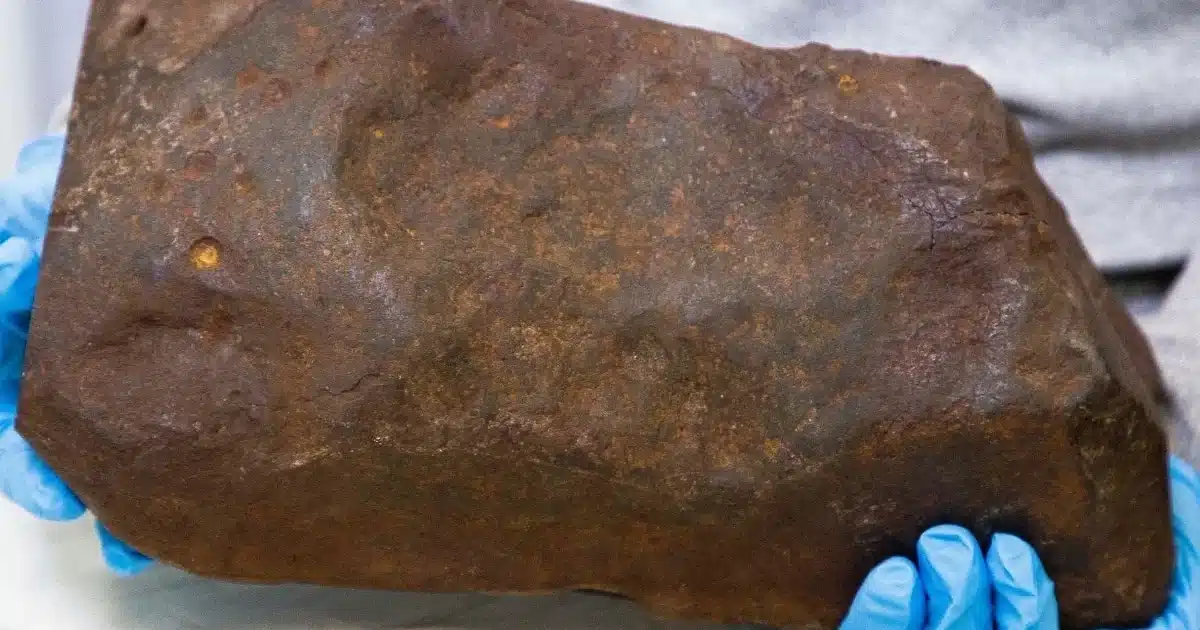
Eventually, Hole brought the rock to the Melbourne Museum, where scientists did what his garage tools could not: they analyzed it properly. The identification was unambiguous. The object was a meteorite, now officially named the Maryborough meteorite. Classified as an ordinary H5 chondrite, it is rich in iron, which explains both the metal detector's reaction and the extraordinary weight for its size.
The grooves and pits carved across its surface are textbook signs of atmospheric entry — the rock had been sculpted by friction and heat as it tore through Earth's atmosphere at enormous speed, at some point between 100 and 1,000 years ago, according to carbon dating performed by the museum's researchers.
weight of the Maryborough meteorite — one of only 17 confirmed finds in all of Victoria
The Maryborough meteorite is rarer than gold
That comparison isn't rhetorical. In the entire region of Victoria, Australia, scientists have confirmed only 17 meteorites in total. Gold nuggets, by contrast, have been pulled from that same soil by the thousands since the gold rush era. The Maryborough meteorite is, by any measurable standard, rarer than the gold Hole was searching for.
Its scientific value compounds that rarity significantly. This is not a rock that tells us about Earth's geology. It tells us about the formation of the Solar System itself — a distinction that makes it one of the most significant geological finds ever recorded in Victoria.
Chondrites are stony meteorites that have not been melted or differentiated since their formation. They are among the oldest solid materials in the Solar System, preserving a direct record of conditions during planetary formation.
Chondrules carry a 4.6-billion-year-old record
Inside the meteorite, researchers found chondrules — tiny, spherical mineral grains that are among the oldest solid structures known to science. These grains formed 4.6 billion years ago, during the earliest phase of the Solar System, when gas and dust from a primordial nebula began clumping together under gravity.
What chondrules reveal about planetary formation
Analyzing the composition of chondrules allows scientists to identify which elements were present and how they interacted in the proto-planetary disk surrounding the young Sun. That data feeds directly into models of planetary formation, helping researchers reconstruct the timeline of how rocky bodies — including Earth — coalesced from raw cosmic material.
The Maryborough meteorite's origin is traced to the asteroid belt between Mars and Jupiter, a region that preserved chunks of early Solar System material largely unchanged for billions of years. When one of those chunks gets nudged out of orbit, crosses the inner Solar System, and survives atmospheric entry, it delivers a sample that no spacecraft has yet returned from that region.
A potential link to the origin of life
The scientific stakes extend even further. Some meteorites of this class carry traces of stellar dust or organic molecules — compounds that some researchers believe played a role in seeding the chemistry that eventually led to life on Earth. Whether the Maryborough meteorite contains such traces has not been confirmed in the available findings, but its classification places it within a category of objects scientists study precisely for that reason.
The chondrules inside the Maryborough meteorite are approximately 4.6 billion years old — predating Earth by hundreds of millions of years — making this specimen a direct physical record of the Solar System’s earliest conditions.
A find that reframes what "valuable" means
Hole spent years assuming value meant gold. The Melbourne Museum's verdict reframes the question entirely. A gold nugget has a market price. A well-preserved H5 chondrite meteorite with intact chondrules, recovered from a region with only 17 confirmed meteorite finds in recorded history, carries a scientific weight that no commodity market can price accurately.
The Maryborough meteorite is now considered one of the most significant specimens ever recovered in the state of Victoria. Its surface tells the story of atmospheric entry. Its interior preserves the chemistry of a Solar System being born. And its journey to recognition ran through years of failed saw blades and acid baths in an Australian man's garage — which, in retrospect, is exactly the kind of origin story a 4.6-billion-year-old space rock deserves.